
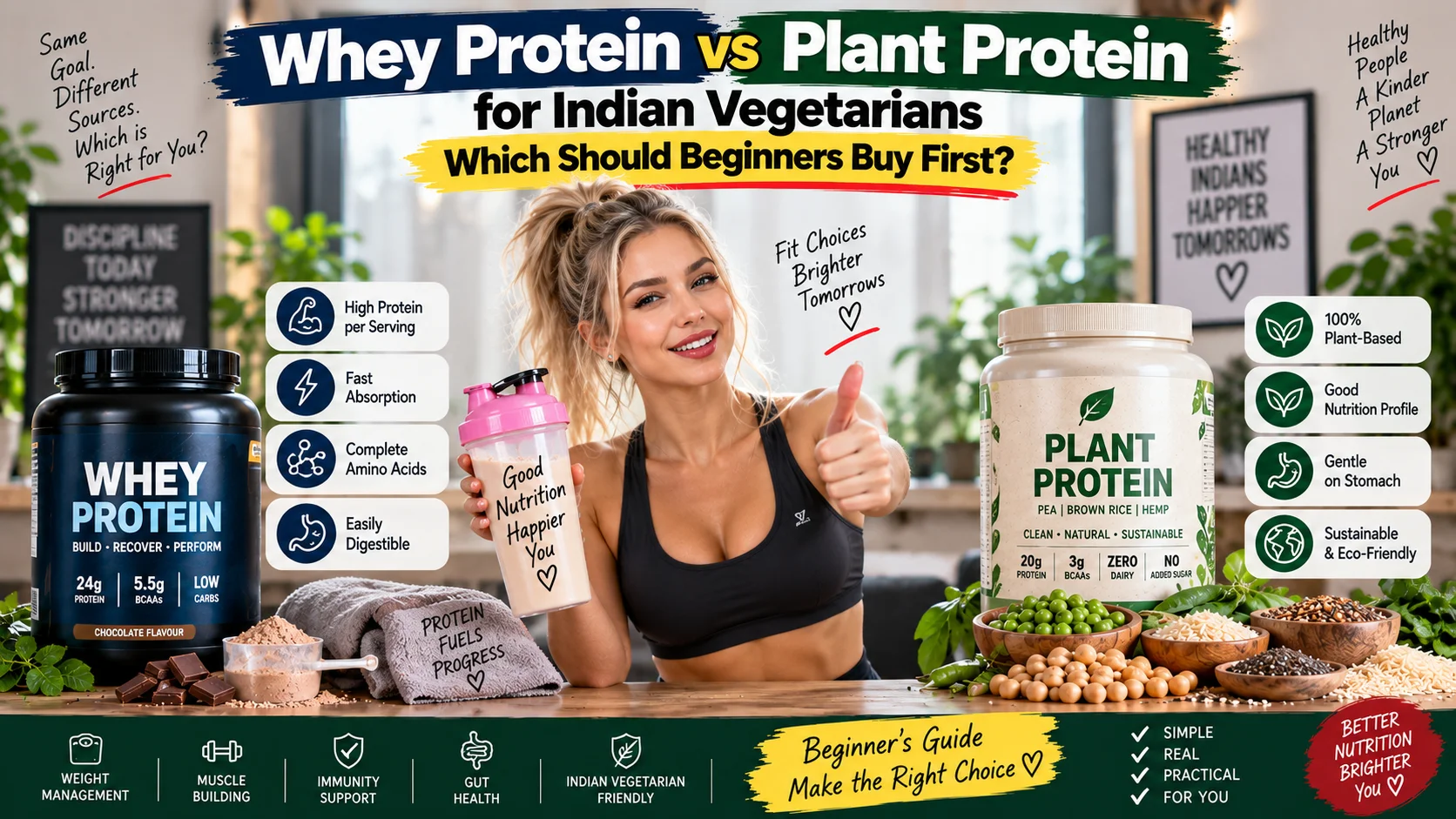
You have started lifting, eating a bit cleaner, and now every second reel is screaming about supplements. The problem: every tub looks promising, but you are stuck on one question — whey protein vs plant protein, which one should you buy first as an Indian vegetarian beginner?
The truth is, both can work well. The better choice for you depends on your digestion, budget, ethics, and how you actually eat in a normal week, not in an ideal “diet plan” on paper.
Why Indian Vegetarians Struggle To Hit Protein Targets
If you are a vegetarian in India, your daily food probably rotates around dal, rice, roti, sabzi, curd, and maybe paneer once or twice a week. That mix is fine for basic health, but most beginners who start training and track intake realise they are 20–40 grams short of a reasonable target.
Protein powder for beginners is not a magic solution, but it does one important job: it lets you add a clean 20–25 grams of protein in 2–3 minutes, without cooking a full meal. That is the gap most office-goers and students cannot fill with just more dal and curd.
Before choosing a tub, it helps to know how much protein you actually need from supplements. Many readers who try to change their diet benefit from using a simple guide like the one in this calorie and macro calculation article so they are not guessing.
Is Whey Protein Vegetarian And How Is It Made?
The first concern Indian vegetarians usually have is simple: is whey protein vegetarian? In most Indian brands, yes, it is. Whey comes from milk. During cheese making, milk is split into solid curds and liquid whey; the liquid part is filtered, dried, and turned into the powder you see in the jar.
The part that makes people uncomfortable is the source of the milk and any added flavours. Strict lacto-vegetarians often check for a green dot (veg symbol) on the label, and many brands clearly print “100% vegetarian”. If you avoid eggs but drink milk and eat paneer, standard whey fits that pattern.
Whey Concentrate Vs Isolate: Which Suits Beginners?
Once you pick whey, the label throws another curveball: whey concentrate vs isolate. Both come from the same milk, but the processing and final composition differ.
Whey concentrate keeps a small amount of milk sugar (lactose) and fat. It usually costs less and tastes creamier, which most beginners appreciate. For people who tolerate milk without issue, concentrate is usually the better starting point instead of isolate.
Whey isolate goes through extra filtration to remove more lactose and fat. That makes it slightly higher in protein per scoop and easier on those with mild lactose sensitivity, but it also tends to be pricier. If regular milk upsets your stomach, isolate can be worth testing with a small pack first.
Plant Protein India: What Goes Inside The Scoop?
Many Indian vegetarian beginners like the idea of protein powder that does not come from milk at all, especially if they are trying to reduce dairy for acne, bloating, or ethical reasons. That is where plant protein India products enter the picture.
Most blends on the Indian market use pea protein, brown rice protein, or a mix of both. Pea protein has a good amount of protein per scoop, and rice helps balance some amino acids that peas lack. The catch: the texture can feel slightly chalky and the flavour is less like a milkshake and more like a thick health drink.
The best way to know if you will tolerate the taste is to buy the smallest pack or sample sachets rather than a giant jar. Many people adjust within a week, especially if they blend it with banana, curd, or oats.
Whey Protein Vs Plant Protein: Key Differences That Matter
When you compare whey protein vs plant protein, do not get too lost in minor label numbers. Look at four practical points: digestion, amino profile, taste, and your values.
Digestion and bloating: Whey usually digests faster, which helps around workouts. Some people feel gassy or get loose motions from lactose, especially with cheap, under-tested brands. Plant protein can cause gas too, particularly pea-based powders if your gut is not used to them, but many people find they adjust with enough water and fibre.
Amino acids and muscle gain: Whey naturally has a complete amino acid profile and higher leucine, which is important for muscle building. Quality plant blends can match this, but you need to check that it is a multi-source blend, not just one grain-based protein with low quality and low leucine.
Taste and mixability: Whey usually wins here. It mixes well in water and milk and feels closer to a milkshake, especially in flavours like chocolate or coffee. Plant protein can feel heavier; many people prefer it with milk alternatives or in smoothies rather than plain water.
Ethics and lifestyle: If your reason for avoiding dairy is strong — ethical, religious, or health-related — a compromise product will always feel wrong. In that case, committing to learning how to make plant protein taste and digest better is worth the effort instead of buying whey and feeling guilty every scoop.
Common Beginner Mistakes With Any Protein Powder
New lifters often assume the powder will fix everything. They buy a big tub, throw in two scoops a day, and barely change their main meals. That is the fastest way to spend money without seeing a visible change in your body or strength.
The second mistake is ignoring the rest of your diet quality. If your plates are still mostly white rice, oil-heavy sabzi and biscuits with chai, your protein supplement is fighting an uphill battle. Combining whey or plant protein with a structured meal plan, such as a guided Indian vegetarian diet for weight loss or recomposition, makes the shake part of a system, not a random extra.
The third mistake is copying a bodybuilder’s scoop size instead of adjusting to your own protein target and training load. Many Indian office-goers actually need just one scoop on training days and maybe none on full rest days if their meals are balanced.
How To Decide Which Protein Powder To Buy First
If your digestion is fine with milk, work long hours, and want something you can shake with water in the office pantry, starting with whey concentrate usually makes the most sense. It is generally cheaper, easier to drink, and widely available in Indian stores and online.
If you are lactose intolerant, vegan, or reducing dairy for skin and digestion reasons, a blended plant protein is the better first buy. Give yourself a week or two to adjust to the taste and see how your body responds; mix it with smoothies rather than only water in the beginning.
For women in India who are already adjusting their diet for fat loss, combining the right shake with a structured plan based on realistic protein targets works best. Guides on topics like daily protein intake for Indian women can make it much clearer how a scoop fits into your actual day of eating.
Whey Protein Vs Plant Protein For Gym Performance
If you train in the morning before work or college, whey can be handy because it digests relatively fast. A scoop with water or milk 30–45 minutes after your session is easy to fit between shower and commute.
Plant protein is slightly slower-digesting, which some people actually like if they train at night and want something that keeps them satisfied closer to bedtime. In practice, both can support muscle gain and recovery as long as your total daily protein intake is on point.
Whey Protein Vs Plant Protein For Weight Loss
For weight loss, the main question is not which powder is “better” but which one helps you stay full and stick to your calorie range without constant snacking. Both whey and plant protein are low in calories relative to the protein they provide, as long as you are not mixing them with a lot of sugar.
What matters more is what the shake replaces. A scoop that replaces a packet of chips and a sugary drink is helpful. A scoop added on top of an already heavy diet just adds calories and frustration when the scale does not move.
Whey Protein Vs Plant Protein For Busy Indian Lifestyles
If you live in a joint family, share a kitchen, or eat canteen food most days, you may not have full control over your meals. A small shaker bottle in your bag can be the difference between hitting your protein goal and getting home late at night on an almost-empty stomach.
In these settings, the best choice is the one you will actually use consistently. Taste, digestion, and convenience beat theoretical advantages. If the idea of a chalky plant shake makes you skip it, whey is better for you. If milk-based drinks always feel too heavy, plant protein will win purely because you will drink it.
Conclusion
If you are choosing your first tub and are confused about whey protein vs plant protein, start from your own body and lifestyle, not social media debates. Check your digestion, your ethics around dairy, and your budget, then choose the option that you can see yourself drinking four to five days a week without struggle.
Indian vegetarians have enough options today to support serious training, and brands like Stay Fit knowledge exist to make those choices simpler. If you train consistently, eat like an adult, and pick one protein powder that fits your routine in India, you are already ahead of most beginners staring at shelves and doing nothing.
Frequently Asked Questions
Q1. Is whey protein safe for Indian vegetarians to drink daily?
Ans: For most Indian vegetarians who already consume milk, curd, or paneer, whey protein is simply a more concentrated form of dairy protein. One scoop a day is generally safe if you do not have kidney disease or severe lactose intolerance. If you feel bloated or get stomach pain, reduce the dose or switch to isolate or plant protein.
Q2. Which is better for beginners in India, whey concentrate or isolate?
Ans: For beginners in India with no trouble digesting milk, whey concentrate is usually a better first choice because it tends to be more affordable and tastes creamier. If you often get gas, loose motions, or acne flare-ups after dairy, starting with a small pack of whey isolate or a non-dairy option is safer.
Q3. Can plant protein alone build muscle for Indian vegetarians?
Ans: Yes, muscle gain is possible with only plant protein as long as your total daily intake and training are on point. Look for blends that combine sources like pea and rice, giving a more balanced amino acid profile. Pair the supplement with higher-protein vegetarian foods such as lentils, curd, and paneer.
Q4. How should I choose a protein powder for beginners on a tight budget?
Ans: If your budget is limited, focus on brands that clearly state protein per scoop, ingredient list, and testing information instead of flashy marketing. Whey concentrate is often cheaper per gram of protein than plant blends, so it can be a smart starting point. Buy a smaller pack first to test digestion and taste before committing to a large tub.
Q5. How many scoops of protein should an Indian vegetarian beginner take?
Ans: Most beginners in India do well with one scoop a day on training days, adjusting based on how much protein they already get from regular meals. Some may need half a scoop on rest days or none at all if their diet includes enough high-protein foods. The goal is to use the powder to fill a gap, not to replace normal food.
Q6. Is whey protein or plant protein better for Indian women trying to lose weight?
Ans: Both can support fat loss if they help Indian women increase protein intake and stay full while staying within their calorie range. Many choose whey for taste and convenience, while others prefer plant options for dairy-free digestion. The better choice is the one that fits easily into your daily meals and that you can stick with for months, not days.